


Introduction
You’re on a video call, in your hand, and 20 minutes pass and you realize you’ve been doing it for the whole time. The next night, lying in bed, phone to your cheek on a call, not thinking about it. All of these times are unimportant. When string them together, day after day though, they’re just the sorts of habits that make acne worse, and they’re not even a cause.
The choice of a cleanser or moisturizer isn’t the only choice when it comes to acne. There are a number of causes, including genetics, hormones and skincare products – but much of what happens to your skin is due to those small habits you probably do without thinking. None of these habits is a sure way to get acne, and changing just one will not help you get rid of acne right away, but if you are aware of a few, it can help a lot in the long run. While we’ve already talked about what you should eat and drink and what you should avoid to help prevent acne, this guide is about the other part — what you should do.
Human nature is to be prone to acne. Everyone naturally has acne-prone skin.
Just one of these bad habits won’t cause too much harm. The issue is the repetition. Having your chin on your hand for one part of a meeting is not a problem. Twenty minutes a day five days a week for months, however, is a different story — this is akin to a consistent, low intensity friction, pressure and transfer of bacteria to your skin, rather than a single isolated event.
The key difference between habits, and perhaps any one bad skin care product, is that the impact of the product is instant and easily reversible. The impact of a habit develops very gradually and subtly, that’s why it can be so easy to overlook! You may think you have the wrong skin, wrong diet or wrong skincare routine to cause a breakout, but it may be the amount of time you spend touching your face or waiting to shower after a workout.
American Academy of Dermatology, in their own acne habits guide, tell us that this is the same pattern — day by day, it’s actions that seem innocuous, but that may result in actual, chronic skin irritation for acne sufferers. The criterion for this entire list is that it is an easy-to-miss habit; not a bad one.
Below are 8 daily habits that could be causing your acne to get worse.
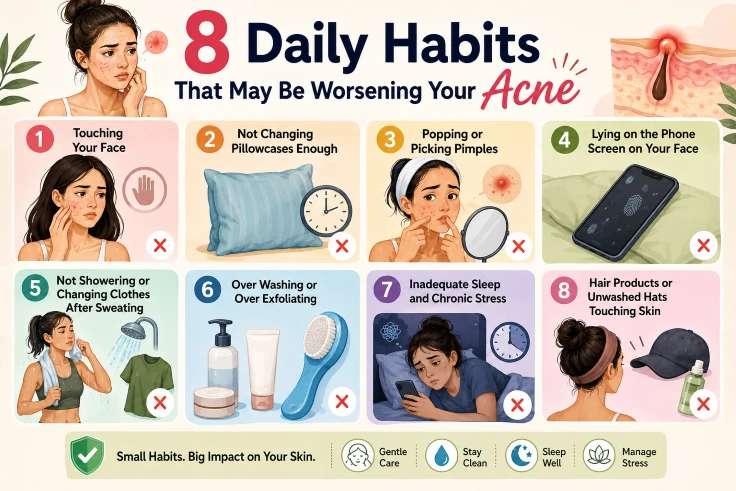
The 8 Daily Habits That May Be Worsening Your Acne
1. Keeping Your Hands to Your Face All Day Long
Puts chin on hand while speaking on the phone. Rubbing jaw when thinking. Fistful of hair! Feeling out hair with hands! It doesn’t seem to happen at all — until you start counting the number of times that it does happen in an hour. It’s important: Your hands come into contact with things like doorknobs, keyboards, phones and other surfaces throughout your day, absorbing oils, dirt and bacteria. Each face touch imparts some of this to your skin and repeated pressure or rubbing can aggravate any lesions, which are already inflamed. What to do: Take steps to develop light awareness rather than an avoidance reaction — a sticky note next to your desk or an object to fidget with during conversation is helpful. Wash your hands more often, too, particularly if you’re rubbing your face frequently and can’t help but do it.
2. Not Changing Under and Over Your Pillow Enough
Do you know the last time that you changed yours? It’s important because you sleep for 6-8 hours with your face against the fabric that continues to absorb the oil, sweat, drool, and skincare residue. That accumulation then is pushed back against your pores, night after night. This is an anecdotal piece of evidence, since no one has ever conducted a controlled study of pillowcases, but it makes sense, and most dermatologists continue to recommend it. What to do: Change your pillowcase every 2-3 days if you tend to break out, or turn it to the other side at least midweek. Use a detergent that doesn’t contain any fragrance if your skin is also sensitive to the fragrance.
3. Popping or Picking at Pimples
Since pimples tend to be quite painful, it is important to avoid popping or picking at them.
You are in front of the mirror at night, and there’s a whitehead that you think you could just get rid of. Why it matters: When a pick is inserted into the skin, it further pushes bacteria and inflammation into the skin, which typically slows the healing process and greatly increases the likelihood of scarring — the opposite of what you’re feeling at the time anyway. The solution: Get a hydrocolloid patch to remove it overnight, as fingers do not work as well on a whitehead. If it’s a deeper, more painful area, a spot treatment with benzoyl peroxide or salicylic acid provides that same urge where it’s not going to cause as deep a pain.
4. Lying on the Phone Screen on Your Face
The reason why it makes acne worse isn’t that complicated, really, as you can see where your phone goes throughout the day, right? pocket, table, gym bag, bathroom counter. What to do about it: Set up speaker mode or use a pair of earbuds for longer conversations, or use an alcohol wipe to clean your screen frequently. The composite of oils that have been deposited on the glass and the heat and pressure that you apply to the glass when making a call can be easily prevented altogether.
5. Not Taking a Shower or Changing Clothes After Sweating
Three hours after that, back to gym, and on to errands, still in the same sweaty leggings and shirt, a common situation for many of us. Why it matters: Sweat, mixed with oil, and the rubbing and squeezing of close-fitting damp clothes on the body causes clogged pores—particularly on the back and chest—as is often said, “bacne” is a real, documented problem, not a myth. The solution: Take a shower within one hour of sweating, and put on different clothes as soon as possible after working out, rather than staying in the same clothes. Breathable fabrics are a huge plus, too, particularly when breakouts happen to be a problem in your own back or shoulders.
6. Over Washing or Over Exfoliating Skin
The more you clean, the less oil you would expect to find. It’s in fact one of the much less counterintuitive things on this list. Why it matters: You might be washing too many times or scrubbing too hard with a washcloth or strong exfoliant, causing your skin’s protective barrier to be removed. The oil glands begin to make even more sebum to make up for it and the physical irritation can also irritate already acne prone skin. The solution: Twice daily is typically the maximum number of times that one should cleanse, but use a mild, non-stripping cleanser, not anything too harsh. Avoid washcloth scrubbing, and use chemical exfoliants 2–3 times a week, your barrier will appreciate it!
7. Inadequate Sleep and Chronic Stress
You’re familiar with this one, though if you are, you probably don’t want to hear it now: Scrolling through the news, to the end of the day, to 1 a.m., and then waking up feeling fatigued, panicky, stressed out about a deadline by 9. Why it matters: Both sleep deprivation and chronic stress can increase cortisol, which increases the amount of oil your skin produces, inflammation, and the rate it heals. This is one of the more established on this list, rather than an anecdotal pattern. The solution: Go to bed and get up at the same time every day and turn your phone off before you go to sleep. Include a few mini stress breaks as well — walking around for a few minutes, taking a few minutes to practice breathing, etc. are achievable stress management steps, not extreme measures.
8. When the Hair Products or Unwashed Hats Touch the Skin
Apply pomade, dry shampoo or leave-in conditioner to the edges of your hairline. A gym cap that is used for 3 days and then not washed. Why it matters: One of the most common causes is oily hair products that are transferred onto the forehead and temples; and unwashed hats or headbands that sit against the skin that they come in contact with harbor sweat and oil. The solution: Avoid using heavier hair products around the sides as much as possible, and wash hats or headbands regularly rather than waiting weeks at a time to wash. Applying oil based products regularly and tying hair back at night also is helpful.
At a Glance: Habit vs. Fix
At a glance, compare the differences between the two.There are a lot of different habits to remember, let’s get the short version here!
Habit | Simple Fix |
Touching your face | Keep hands off face, wash hands more frequently |
Old pillowcase | Change every 2–3 days |
Popping pimples | Use a patch or spot treatment with hydrocolloid. |
Phone against face | To ensure good visibility of the screen, use speaker/headphones and clean the screen regularly. |
Skipping post-sweat shower | Take a shower within 1 hour, change clothes quickly |
Over-washing/over-exfoliating | Wash 2 times a day (maximum), and exfoliate 2-3 times a week |
A lack of sleep and stress | Getting up and going to bed at the same time every day and taking occasional rest breaks from stress. |
Hair products/unwashed hats | Do not allow products to come in contact with the hairline; wash your hat regularly. |
Which of These Habits Do You Have?
Not all of these habits are appropriate for everyone — this is a simple method for identifying which are the ones you should consider:
☐ I don’t shower immediately after I sweat a lot during the day
☐ I wash my face more than twice a day
☐ I rub my face with my phone while talking on the phone
☐ I sleep on the same pillow case for more than a week
☐ I have been sleeping less than 7 hours a night for the past few days
☐ I have touched my face without thinking in the last few days
☐ I have picked at an itch or pimple in the last few days
☐ My hair product or hat rubbed against my forehead a lot during the day
If you checked 2 or 3, you should begin with those and not all 8.

Skin Care Magic: A Daily Routine of Fixes for Clearer Skin
Skin Care Magic is a daily routine of fixes for clearer skin!
Morning: Gentle cleanse, NO double scrubbing to “wake up the skin.”
Midday: Pay attention to any hand-on-face behaviours when you’re on the phone or working on focused tasks – and have something to do with hands.
Post-workout: Shower and change clothes inside an hour, don’t stay in sweaty clothes.
Evening: Clean your phone screen and if you have long hair, secure it back up.
Before sleep: Wash once before going to bed, avoid using harsh scrubbing products and ask yourself if it’s time for a pillowcase change.
Overnight: If late night scrolling is taking a toll on your sleep, try to keep the device off the pillow and out of arm’s reach.
A 2-Week Reset Plan to Help If You Are Feeling Stressed
Starting all 8 habits on Monday morning is the quickest way to getting back on the wagon by Wednesday. It is better to go through the stages.
Week 1: Choose two of the habits from the self-check above that you feel are related, such as face-touching and phone screen contact, so that fixing both of these habits at the same time will reinforce the same awareness. Just concentrate on those two for 7 days. Don’t be concerned on the rest at the moment.
Week 2: If you can keep the first two in place, it’s on autopilot now, add in one or two more: Pillow case changes, post workout showers are easy to add as they are more about scheduling than willpower. Leave the tougher behavioral ones—such as a habit of popping or trouble sleeping—for when the easy stuff comes more easily.
This is not a rigid formula; it’s about sequencing and not about a deadline. The two habits consistently practiced for two weeks overcame all eight attempts started and then given up.
How These Habits Affect Oily, Dry, and Sensitive Skin Differently
It is important to note that not all habits will impact the skin in the same way, and don’t presume that every skin care solution will be right for you.
Oily skin is the most affected when overwashed and over-exfoliated, as the increased sebum production in response to over-washing and exfoliating will work against a skin surface that already produces more oily skin to start with. Another area of transfer is on the hair line, which is quicker to appear on oily skin.
If you have dry or sensitive skin, you may notice the effects of friction creating rashes, redness, and irritation instead of clogged pores as a result of pillowcases, phone screens, and rough exfoliation. This is even more problematic because of the slower healing of a damaged barrier.
Combination skin generally displays the most obvious pattern in the T-zone where there is the most oil production, and where the skin is most likely to be affected by the contact with a phone or pillowcase. If the breakouts don’t seem to be distributed evenly, it may be worth considering if one of these habits matches the zone where the breakouts are occurring.
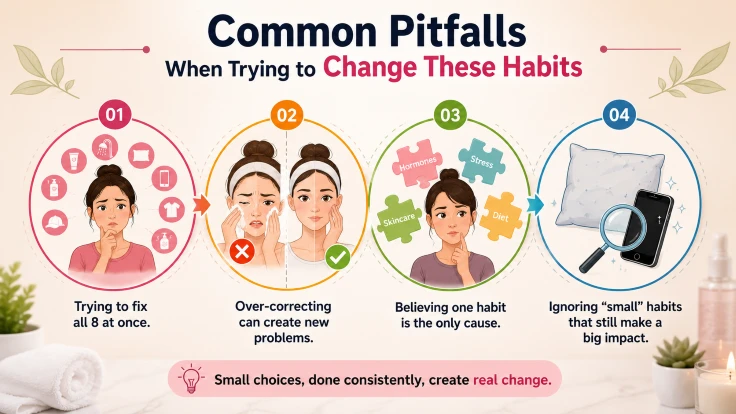
Common Pitfalls When Trying to Change These Habits
Some of the most frequent pitfalls in attempting to change these habits are:
- Attempting to fix all 8 at the same time. This is a formula that leads to giving up in just a week. Choose one or two of your self-check list items and develop on those points.
- Over-correcting. If you were washing your face five times a day and now wash it once in a while, that’s going to cause you a problem — just not the same one.
- There’s a misconception that blaming one of the habits is enough to solve the problem when it has several reasons. It’s typically a combination of hormone, stress, skincare routine and diet that have an impact, and it’s rarely just one thing alone.
- Skipping behaviors that may be thought of as “small behaviors.” A pillowcase or a phone screen seems insignificant when compared to hormones — but just a little bit of contact can add up to a lot more than one explanation can.
Habits Aren’t the Whole Story: When to See a Dermatologist
No, changing these habits won’t cure acne if it’s primarily caused by hormones, genetics or a medical condition but it can make a significant difference in helping.
If you’ve suffered with painful, cystic acne, noticeable scaring, and have been making significant changes to your habits for 2 to 3 months without any results, it’s time to seek the help of a professional. If out-of-the-blue breakouts are sudden and severe and won’t go away, it’s time to see a dermatologist. But none of this suggests that habit changes don’t exist — that habit changes are not to be tried, but rather that there is an interdependence between habit changes and professional treatment. These daily adjustments will take care of what you can do day to day, while a dermatologist will take care of what you can’t see day to day.
Conclusion
Each of these eight habits does not have any one particular effect on your skin; it will either help you to clear it or destroy it. When they’re combined, however, they form the really useful list of acne-sneaking habits that are easy to slip up on — just because they aren’t individually dramatic to you. Choose one or two items from your self-check list; practice one or two items from that list for a couple of weeks, and then follow the rest at your speed. That’s a far more sustainable approach than trying to overhaul your entire routine overnight.
If diet is more your focus right now, we covered how sugar and dairy spike insulin and IGF-1 in 12 Best and Worst Drinks for Acne-Prone Skin — the same hormonal pathway shows up again here with sleep and stress, just triggered a different way.
Q1. Is there any connection between sleep positions and acne?
Laying face down or on your side places pressure on the skin for hours, causes more contact with pillow case “buildup” and friction against one side of the face. Lying on your back will minimize that contact, but may not be feasible for all.
Q2. Do dirty make-up brushes cause acne?
Yes – old product, old oil and bacteria build up in the makeup brushes used with each use, and putting product on with a dirty brush puts the product, oil and bacteria back on your skin. Clean brushes weekly is a relatively simple, and easily overlooked, solution.
Q3. How often should I wash pillow-cases?
Most dermatologists recommend twice to thrice a week for breakout-prone skin, and once a week for skin that’s not prone to breakouts — and that’s just a matter of how oil and bacteria build up on your skin.
Q4.Does mask use, or mask wearing (in sports, in the workplace, etc.), cause acne?
Yes, it is a common enough condition which has been given its own name: “maskne.” The frequent use of masks over long periods can cause pores to be clogged because of the pressure, heat and moisture that build up on the bottom side. Using a breathable fabric and changing your masks after every use helps.
Q5. Has anyone ever found it ok to pop a pimple?
Usually, dermatologists will not recommend it, but if a whitehead is actually going to break on its own, it’s not as risky to perform a very gentle and clean-hands method with little or no digging as it would be for an inflamed whitehead. If in any doubt, opt for spot treatment instead.