


Small Habits, Big Impact
You don’t need to overhaul your entire life to feel better mentally. Sometimes, all it takes is a five-minute change in your morning or a single deep breath in the middle of a chaotic afternoon. Daily habits for mental health are not grand gestures — they are tiny, consistent actions that quietly shape how you think, feel, and function every single day. This guide will show you exactly how to build those habits, one practical step at a time.
The Link Between Daily Habits and Mental Health
Think of your mental health like a garden. If you water it daily — even just a little — it stays healthy and resilient. But if you ignore it for weeks, weeds of stress, anxiety, and burnout start to take over.
Science backs this up. Research consistently shows that our daily routines directly influence brain chemistry, emotional regulation, and cognitive performance. Simple actions like getting enough sleep, moving your body, or practicing gratitude trigger the release of feel-good neurotransmitters like serotonin and dopamine. Over time, these daily self-care habits rewire neural pathways, making it easier to stay calm, focused, and emotionally stable.
The good news? You already have a routine. The goal is to make it work for your mental wellness instead of against it.
Benefits of a Mental Health Routine
Before diving into specific habits, it helps to understand why a structured mental health routine matters. Here is a quick overview:
| Benefit | What It Means for You |
| Stress Management | Lower cortisol, calmer response to daily challenges |
| Focus & Productivity | Sharper thinking, fewer distractions throughout the day |
| Emotional Stability | More resilience when things don’t go as planned |
| Physical Energy | Better sleep, improved circulation, and reduced fatigue |
Improved Stress Management
Chronic stress is one of the biggest threats to mental wellness. When you build habits that activate your parasympathetic nervous system — like deep breathing or morning walks — you train your body to recover from stress faster. Healthy habits for stress relief act like a reset button your brain can count on.
Increased Focus and Productivity
A cluttered mind is an unproductive mind. Daily rituals like journaling, single-tasking, and mindful breaks clear mental fog. You will notice sharper concentration, better decision-making, and a stronger sense of control over your day.
Greater Emotional Stability
When you consistently care for your mind, you become less reactive. Small triggers stop feeling like catastrophes. Emotional well-being improves not because life gets easier, but because you get stronger.
Enhanced Physical Energy
Mental health and physical health are deeply connected. Poor mental health drains your body. Strong mental habits — good sleep, hydration, exercise — directly boost physical energy levels, creating a positive upward spiral.
Morning Habits to Start Your Day Right
How you start your morning sets the tone for everything that follows. Think of your first 30 minutes as the foundation of your entire mental health routine. Here is what works.
Mindful Waking Without Technology

Resist the urge to grab your phone the moment you wake up. Scrolling through news or social media floods your brain with stress signals before your mind is even fully awake. Instead, spend the first five minutes breathing slowly, stretching, or simply sitting in silence. This small shift protects your cognitive health and sets a calm, intentional tone for the day.
To complement this habit, consider pairing it with some gentle morning movement to get your blood flowing and energy levels rising naturally.
Immediate Hydration and Nutrition
Your brain is roughly 75% water, and even mild dehydration impairs focus and mood. Drink a full glass of water before anything else. Follow it with a balanced breakfast — think whole grains, protein, and healthy fats — to fuel steady energy and prevent the mood crashes that come with blood sugar spikes.
Natural Sunlight Exposure
Step outside or sit by a window within 30 minutes of waking up. Natural light regulates your circadian rhythm, boosts serotonin levels, and signals to your brain that it is time to be alert. Even 10 minutes of morning sunlight is a powerful, free mental wellness tip that most people overlook.
Brief Gratitude Journaling
You do not need a beautiful journal or an hour to spare. Just write three things you are grateful for each morning. This practice rewires your brain toward positive mindset habits, reducing the negativity bias that naturally pulls attention toward problems. Over time, journaling for mental clarity becomes one of the most effective daily habits for anxiety management available.
| ⭐ Quick Morning Mental Health Checklist |
| No phone for the first 10 minutes |
| Drink a full glass of water |
| Get 10 minutes of natural sunlight |
| Write 3 things you are grateful for |
| Do 5–10 minutes of movement or stretching |
How to Stay Mentally Healthy During a Busy Workday
Work is one of the biggest sources of mental strain for most people. These mental health tips for busy professionals can help you protect your mind without sacrificing productivity.
Taking Structured ‘Micro-Breaks’
Your brain cannot focus intensely for eight straight hours. It is not built that way. The Pomodoro Technique — 25 minutes of focused work followed by a 5-minute break — is one of the most researched productivity and mental wellness strategies available. Use break time to stand, breathe, stretch, or look out a window. These micro-breaks reduce mental fatigue and restore attention.
Practicing Box Breathing Exercises
Box breathing is a simple, quick way to reduce stress daily. Here is how it works: inhale for 4 counts, hold for 4 counts, exhale for 4 counts, hold for 4 counts. Repeat four times. This technique activates the parasympathetic nervous system, lowering cortisol almost immediately. You can do it at your desk without anyone noticing.
Setting Digital Boundaries
Every notification is a micro-interruption that fragments your focus and raises stress. Batch your emails into two or three dedicated check-in windows per day. Turn off non-essential app notifications. Consider a ‘no phone during lunch’ rule. These digital detox habits are surprisingly powerful for protecting your attention and emotional bandwidth.
Prioritizing Single-Tasking
Multitasking is a myth — what you are really doing is rapidly switching between tasks, which exhausts your prefrontal cortex and increases error rates by up to 40%. Single-tasking is one of the simplest work-life balance tips with a massive payoff. Choose one task, commit to it fully, and you will finish faster and with less mental drain.
The Role of Nutrition and Movement in Mental Wellness
Improving mental health through nutrition and exercise is not just a wellness trend — it is hard science. What you eat and how you move directly shapes your brain’s chemistry and structure.
Eating Mood-Boosting Whole Foods
Processed foods, refined sugar, and excess caffeine create inflammation that disrupts brain function and contributes to low mood. On the flip side, whole foods rich in omega-3s (like salmon and walnuts), antioxidants (berries, leafy greens), and B vitamins (eggs, legumes) actively support cognitive health and emotional stability. These are your frontline mood-boosting foods.
The Connection Between Gut Health and Brain Health
The gut-brain axis is one of the most exciting areas of modern neuroscience. Roughly 90% of your serotonin is produced in your gut, not your brain. This means the health of your digestive system has a direct, measurable impact on your mood, anxiety levels, and mental clarity. For a deeper dive into how food choices influence your mind, explore the science of gut health and how a balanced microbiome can transform your emotional well-being.
Quick Bodyweight Movements or Stretching
You do not need a gym membership to support your mental health through movement. Ten minutes of bodyweight squats, pushups, or yoga stretching releases endorphins, reduces cortisol, and increases BDNF — a protein that literally helps your brain grow new neurons. Even a brisk 10-minute walk during lunch counts. The key is consistency, not intensity.
Staying Consistently Hydrated
Dehydration is a stealthy mood killer. Studies show that losing just 1–2% of body water impairs short-term memory, increases anxiety, and reduces concentration. Aim for 6–8 glasses of water throughout the day. A reusable water bottle on your desk serves as a constant visual reminder. This is one of the easiest simple habits for a better mood that costs nothing.
Evening Habits for a Restful Mind
Your evening routine is just as important as your morning one. These habits signal to your brain and body that it is safe to wind down.
Blue Light Reduction Before Bed
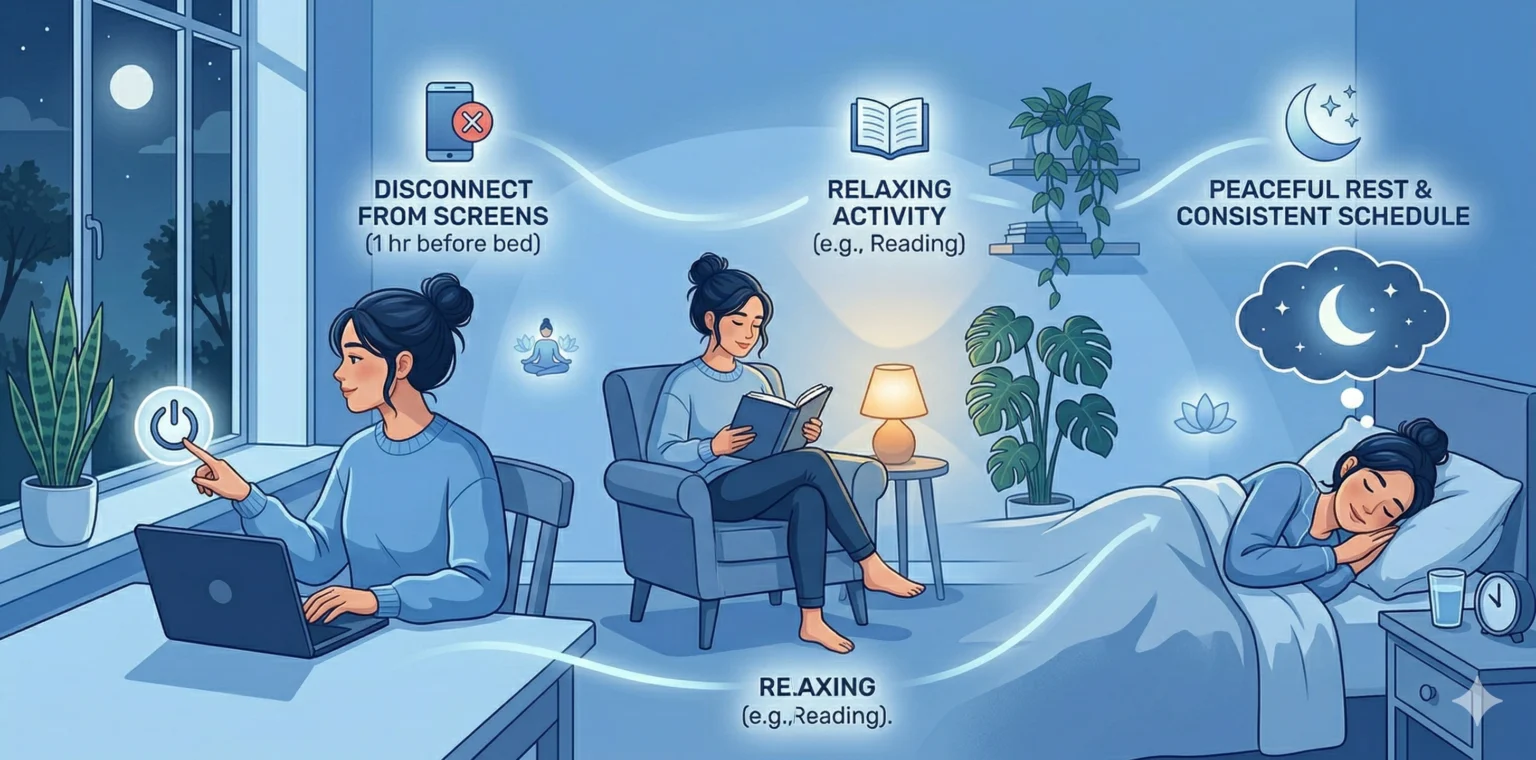
The blue light emitted by phones, tablets, and laptops suppresses melatonin production — the hormone that tells your body it is time to sleep. Aim to stop using screens at least 60 minutes before bed. Replace screen time with reading a physical book, light stretching, or a warm shower. This single change can dramatically improve sleep quality.

Brain Dumping to Clear Thoughts
Racing thoughts at bedtime are a common sign of an overloaded mind. A ‘brain dump’ is simple: grab a notebook and write down everything on your mind — to-do lists, worries, unfinished thoughts. This externalizes your mental load, signaling to your brain that these items are stored safely and no longer require active processing. You will fall asleep faster and wake up with more mental clarity.
Establishing a Consistent Sleep Schedule
Going to bed and waking up at the same time every day — yes, even on weekends — is one of the most powerful habits for mental health available. Consistency regulates your circadian rhythm, improves mood, sharpens memory, and reduces anxiety. If you struggle with this, check out our guide to a consistent sleep schedule for practical, science-backed strategies to make it stick.
| 🌙 Evening Wind-Down Checklist |
| Stop screens 60 minutes before bed |
| Do a 5-minute brain dump in a notebook |
| Keep bedroom cool and dark |
| Go to bed at the same time each night |
| Avoid caffeine after 2 PM |
How to Build Habits That Actually Stick
Knowing what to do is the easy part. Doing it consistently, especially on hard days, is where most people struggle. Here is how to make these daily self-care habits durable.
Using the Habit Stacking Method
Habit Stacking is the strategy of attaching a new habit to an existing one. For example: ‘After I pour my morning coffee (existing habit), I will write three gratitude lines (new habit).’ This leverages the neural pathways you already have, making the new behavior far easier to adopt. It is one of the most evidence-based approaches to building lasting habit stacking for wellness.
Starting with Five-Minute Wins
The biggest mistake beginners make is trying to change too much too fast. Instead, start with five-minute versions of each habit. Five minutes of journaling. Five minutes of stretching. Five minutes without your phone. Small wins build momentum, and momentum builds consistency. This approach aligns perfectly with easy self-care ideas for beginners who feel overwhelmed by traditional wellness advice.
Tracking Your Daily Progress
What gets measured gets managed. Use a simple habit tracker — a printed checklist, a whiteboard, or a free app — to mark off your habits each day. The visual chain of check marks creates a psychological reward that makes you want to keep the streak going. Even tracking just three habits at a time is enough to create meaningful change.
Practicing Self-Compassion During Setbacks
You will miss days. Life happens. The difference between people who build lasting habits and those who don’t is not perfection — it is how they respond to imperfection. Treat a missed day the way you would treat a good friend who missed the gym: with understanding, not judgment. Self-compassion is not a soft skill. Research by Dr. Kristin Neff shows it is a core predictor of long-term behavior change and emotional well-being.
Frequently Asked Questions
How long does it take to see results?
Most people notice mood improvements within 1–2 weeks of consistent practice. Deeper neurological changes take 4–8 weeks. Consistency matters far more than perfection.
What is the single most important habit?
Sleep. Without 7–9 hours of quality sleep, every other mental health habit becomes significantly less effective. Sleep is the non-negotiable foundation.
Can habits replace therapy or medication?
No. These habits are powerful complements to professional care, not replacements. If you are managing a diagnosed condition, always work with a qualified healthcare provider.
How do I stay consistent when unmotivated?
Motivation is unreliable — build systems instead. Use habit stacking, keep habits small (under five minutes), and track your streak. Systems work even when motivation doesn’t.
What if my schedule is too busy for a routine?
Start with just one habit: a two-minute gratitude journal or a single glass of water at wake-up. One anchored habit creates momentum for more. Busy schedules make routines more important, not less.
Are there foods that reduce anxiety?
Yes. Fatty fish, dark leafy greens, fermented foods, blueberries, and magnesium-rich foods like pumpkin seeds are among the best mood-boosting foods for anxiety. See our full guide to stress-relief foods for a complete list.