

Hair care tips can make a meaningful difference to the way your hair looks, feels and manages everyday stress. A good hair routine does not need to include a large number of products or complicated steps. Consistent washing, proper conditioning, gentle handling, scalp care, good nutrition and protection from heat can all support healthier-looking hair.
Hair is exposed to many forms of stress every day. Frequent washing with unsuitable products, excessive heat styling, chemical treatments, tight hairstyles, rough brushing and environmental exposure can contribute to dryness, breakage and other forms of hair damage. The American Academy of Dermatology Association recommends adapting hair care to your hair type and being gentle when washing, drying and styling.
It is also important to understand that hair care is not the same as treating a medical hair or scalp condition. If you notice persistent hair fall, sudden thinning, bald patches, scalp changes or other unusual symptoms, professional assessment may be more appropriate than relying only on home remedies.
Why Hair Care Is Important?
Healthy hair starts with a healthy approach to daily care. Your scalp provides the environment from which hair grows, while the hair shaft needs protection from repeated physical and chemical stress.
A suitable hair care routine can help you:
- Reduce unnecessary hair breakage
- Keep the scalp clean and comfortable
- Maintain moisture and manageability
- Reduce damage caused by excessive heat
- Prevent unnecessary pulling and tension
- Keep hair looking smoother and healthier
- Support overall hair health
- Identify changes in hair or scalp condition earlier
Hair care is also highly individual. Straight, curly, fine, thick, dry and textured hair can have different needs. Choosing products and routines according to your hair type is more useful than following every trend you see online.
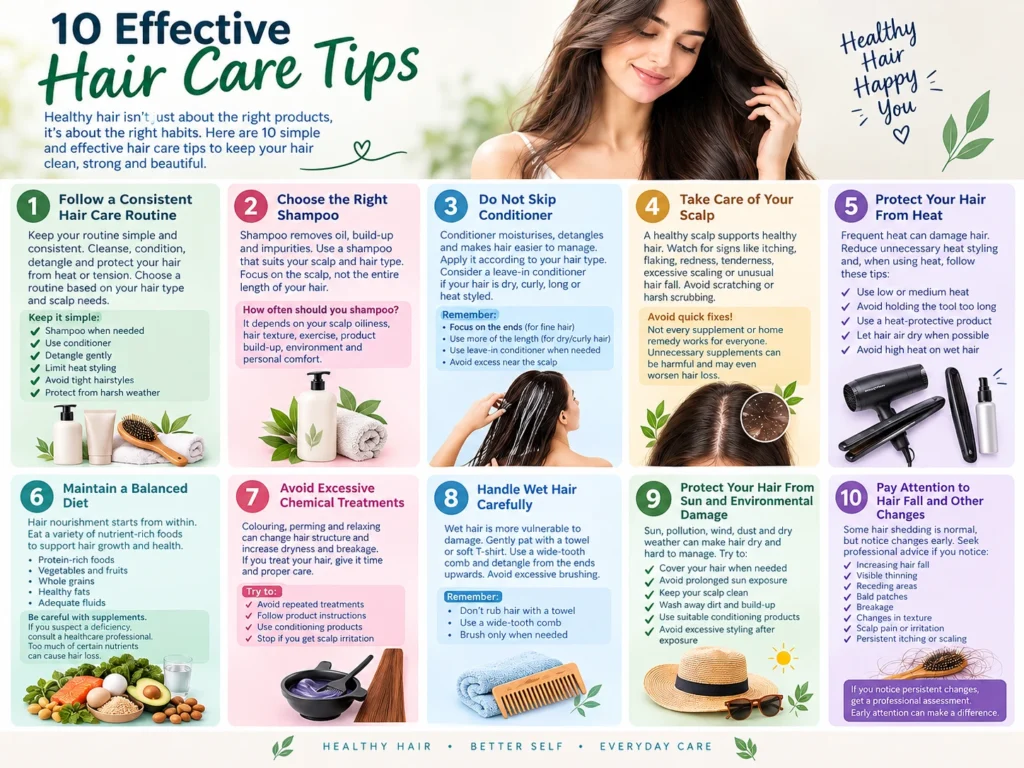
10 Effective Hair Care Tips
1. Follow a Consistent Hair Care Routine
One of the most useful hair care tips is to create a routine that you can follow consistently.
A simple hair routine may include cleansing the scalp, conditioning the hair, gentle detangling and protecting the hair from unnecessary heat or tension. You do not need to use numerous products to maintain healthy hair.
Start by understanding what your hair actually needs.
For example, someone with an oily scalp may need more frequent washing, while someone with dry or curly hair may need a different washing schedule. The American Academy of Dermatology recommends washing based on how dirty or oily the hair becomes rather than following one fixed schedule for everyone.
Keep Your Routine Simple
A practical routine can include:
- Shampoo when your scalp needs cleansing
- Use conditioner after washing
- Detangle gently
- Limit unnecessary heat styling
- Avoid hairstyles that pull tightly
- Protect hair when exposed to harsh environmental conditions
The goal is consistency rather than complexity.
2. Choose the Right Shampoo
Shampoo helps remove excess oil, product build-up, dead skin and other impurities from the scalp.
However, using a shampoo that does not suit your hair type can leave your hair feeling excessively dry or uncomfortable. Instead of choosing a product only because it is popular, consider your scalp and hair needs.
One important hair care tip is to focus shampoo mainly on the scalp, rather than aggressively applying it throughout the entire length of the hair. This helps clean the scalp while reducing unnecessary drying of the hair lengths.
How Often Should You Shampoo?
There is no single correct frequency.
Your washing schedule may depend on:
- Scalp oiliness
- Hair texture
- Exercise and sweating
- Product build-up
- Environmental exposure
- Hair dryness
- Personal comfort
If your scalp becomes oily quickly, you may need to wash more often. If your hair is dry, curly or thick, you may not need to shampoo as frequently.
3. Do Not Skip Conditioner
Conditioner is an important part of a basic hair care routine because it helps moisturise and detangle the hair.
After shampooing, apply conditioner according to your hair type. People with fine or straight hair may prefer concentrating conditioner towards the ends, while dry or curly hair may benefit from conditioning more of the hair length.
Conditioning can also make hair easier to manage and reduce the amount of pulling needed during brushing or combing.
Consider a Leave-In Conditioner When Appropriate
Some people may benefit from a leave-in conditioner, particularly when their hair is dry, long, curly, chemically treated or frequently heat styled. A leave-in conditioner can help make hair easier to detangle and manage.
Use these products according to their instructions and avoid applying products excessively to the scalp unless they are specifically designed for scalp use.
4. Take Care of Your Scalp
Scalp care is an important part of maintaining healthy hair. A clean and comfortable scalp supports a good foundation for your overall hair routine.
Pay attention to changes such as:
- Persistent itching
- Excessive flaking
- Redness
- Tenderness
- Unusual scaling
- Sudden changes in hair density
- Persistent or worsening hair fall
Avoid aggressively scratching or scrubbing your scalp. Your scalp can also be affected by unsuitable hair products, excessive product build-up and certain hair or skin conditions.
Avoid Every Trend You See Online
Social media often promotes quick fixes for hair growth and hair fall. However, a home remedy or supplement that works for one person may not be suitable for another.
The American Academy of Dermatology warns that taking unnecessary supplements can sometimes be harmful, and some nutrient excesses can actually worsen hair loss.
5. Protect Your Hair From Heat
Frequent exposure to high temperatures can contribute to hair damage. Blow dryers, straighteners, curling irons and other heated tools can weaken hair when used excessively.
One of the most practical hair care tips is to reduce unnecessary heat styling.
When you do use heat:
- Choose a low or medium heat setting
- Avoid holding the tool in one area for too long
- Use a suitable heat-protective product
- Allow hair to partially air dry when possible
- Avoid frequent high-temperature styling
Dermatologists recommend limiting heat exposure and using lower heat settings to reduce damage.
You should also avoid using heated styling tools on soaking-wet hair unless the tool is specifically designed for that purpose.
6. Maintain a Balanced Diet
Hair nourishment starts from within. Your body needs adequate energy and nutrients to support normal hair growth and overall health.
A balanced diet can include:
- Protein-rich foods
- Vegetables
- Fruits
- Whole grains
- Healthy sources of fats
- Adequate fluids
- A variety of nutrient-rich foods
Protein is particularly relevant because hair is largely made up of a protein called keratin. Inadequate nutrition can contribute to hair problems, and severe calorie restriction can also be associated with significant hair loss.
Be Careful With Hair Growth Supplements
Supplements are not automatically better for hair health.
If you suspect a nutritional deficiency, it is better to discuss it with an appropriate healthcare professional rather than taking high-dose supplements without guidance. Too much of certain nutrients can contribute to hair loss.
7. Avoid Excessive Chemical Treatments
Hair colouring, relaxing, perming and chemical straightening can change the structure of hair. Repeated chemical processing may increase dryness and breakage.
If you regularly colour or chemically treat your hair, give it appropriate care between treatments.
Try to:
- Avoid unnecessary repeated treatments
- Follow product instructions
- Give your hair time between chemical processes
- Use conditioning products suitable for treated hair
- Stop using a product if it causes significant scalp irritation
Professional application may also be preferable for chemical services, particularly when you are unsure how a product should be used.
The AAD recommends caution with colouring, perming and chemical straightening because these processes can contribute to hair damage.
8. Handle Wet Hair Carefully
Wet hair is more vulnerable to damage, so the way you dry and detangle it matters.
Avoid aggressively rubbing your hair with a towel. Instead, gently wrap your hair in a towel or soft T-shirt to absorb excess moisture.
When detangling, use a suitable wide-tooth comb and work gently through the ends before moving upwards. The best approach can vary depending on hair texture.
Avoid Excessive Brushing
Brushing your hair repeatedly throughout the day is not necessary for healthy hair.
Too much brushing can contribute to mechanical damage and split ends. Instead, brush or comb only as much as needed for styling and detangling.
9. Protect Your Hair From Sun and Environmental Damage
Your hair can also be affected by everyday environmental exposure.
Sun exposure, dry weather, pollution, wind, dust and other environmental factors can make hair feel dry or difficult to manage.
Simple protective habits include:
- Covering your hair when appropriate
- Avoiding unnecessary prolonged sun exposure
- Keeping your scalp clean
- Washing away accumulated dirt and product build-up
- Using suitable conditioning products
- Avoiding excessive styling after environmental exposure
If you spend a lot of time outdoors, consider how your overall hair routine can minimise exposure and maintain moisture.
10. Pay Attention to Hair Fall and Other Changes
Some hair shedding is normal, but noticeable or persistent changes deserve attention.
Do not ignore signs such as:
- Increasing hair fall
- Visible thinning
- Receding areas
- Bald patches
- Significant breakage
- Changes in hair texture
- Scalp pain or irritation
- Persistent itching or scaling
Hair loss can have many possible causes. If you notice sudden or persistent hair loss, visible thinning or bald patches, consider seeking professional advice. Healthdirect Australia’s guide to hair loss provides reliable information about common causes of hair loss and when to seek medical advice.
Natural Hair Care
Natural hair care does not necessarily mean using homemade ingredients or avoiding every conventional hair product.
Instead, it can mean taking a gentle and practical approach to your everyday routine.
Useful natural hair care habits include:
- Avoiding unnecessary heat
- Choosing products suited to your hair type
- Keeping your scalp clean
- Eating a balanced diet
- Drinking enough fluids
- Avoiding tight hairstyles
- Handling wet hair gently
- Limiting excessive chemical processing
Remember that “natural” does not automatically mean safe or effective. Some ingredients promoted online can irritate the scalp or cause unwanted reactions.
Hair Care Tips at Home
There are several hair care tips you can follow at home without making your routine complicated.
Start with the basics. Wash your hair according to your scalp’s needs, condition after shampooing, detangle gently and reduce excessive heat.
You can also make your routine easier by preparing your products and tools in advance. Keep a wide-tooth comb available, use a clean towel or soft T-shirt for drying, and avoid styling your hair immediately with high heat after washing.
Build a Weekly Hair Routine
A simple weekly approach might look like this:
Wash days:
Clean your scalp with a suitable shampoo and follow with conditioner.
After washing:
Gently remove excess water and detangle without pulling.
Styling days:
Keep heat use limited and choose lower temperature settings when possible.
Throughout the week:
Avoid tight hairstyles and pay attention to scalp comfort and changes in hair fall.
The exact routine should be adjusted according to your hair type, scalp condition and lifestyle.
Common Hair Care Mistakes to Avoid
Even a good hair routine can become less effective if you repeatedly make common mistakes.
Washing With Very Hot Water
Very hot water may leave hair feeling dry. Use comfortable water temperatures and focus your cleansing on the scalp.
Using Too Many Products
More products do not automatically mean healthier hair. Too much product can create build-up and make hair difficult to manage.
Brushing Aggressively
Pulling through knots can cause breakage. Detangle gradually and gently.
Frequent High-Heat Styling
Regular high-temperature styling can increase hair damage. Give your hair breaks from heat whenever possible.
Wearing Tight Hairstyles Frequently
Repeated tension from tight ponytails, buns, braids or extensions can contribute to traction-related hair loss.
If a hairstyle causes pain, stinging or noticeable pulling on the scalp, it is a sign that the style may be too tight.
Following Unverified Hair Growth Remedies
Be cautious about products or remedies that promise guaranteed hair growth or instant results. Hair loss can have different causes, so the right approach depends on the individual situation.
When Should You Seek Professional Advice?
Good hair care can help reduce preventable damage, but it cannot address every possible cause of hair loss or scalp problems.
Consider seeking professional advice if you notice:
- Sudden or significant hair loss
- Persistent thinning
- Bald patches
- A rapidly changing hairline
- Persistent scalp itching or irritation
- Pain, redness or scaling
- Hair loss that continues despite improving your routine
- Concerns about possible nutritional deficiencies
A professional can help determine whether your concern is related to everyday hair care, a scalp issue, nutritional factors or another underlying cause. Dermatologists are trained to diagnose conditions affecting the hair, scalp, skin and nails.
This is particularly important if you are considering medication or supplements for hair loss. Avoid starting such products based only on online recommendations.
How GoHealthyPro Can Help?
GoHealthyPro should only be positioned around the services and resources it actually provides. As the official website could not be accessed reliably during this check, I have not attributed a specific hair treatment, hair consultation, hair-loss service or hair-growth procedure to GoHealthyPro.
If the website has a relevant health or wellness resource that supports general wellbeing, you can mention it naturally without suggesting that the platform provides a dedicated hair treatment.
For readers concerned about persistent hair or scalp changes, the most responsible approach is to seek advice from a qualified healthcare professional who can assess the concern appropriately.
How to Get Started With Better Hair Care?
You do not need to change everything at once.
Start with a few simple steps:
- Identify your hair and scalp type.
- Review how often you wash your hair.
- Choose shampoo and conditioner suited to your needs.
- Reduce unnecessary heat styling.
- Handle wet hair gently.
- Avoid tight hairstyles.
- Maintain a balanced diet.
- Pay attention to changes in hair fall or scalp health.
- Avoid unverified quick-fix treatments.
- Seek professional advice when symptoms persist.
The best hair care tips are the ones you can follow consistently. Your hair does not need a complicated routine. It needs appropriate care, gentle handling and attention to changes over time.
FAQs About Hair Care Tips
What are the most important hair care tips for healthy hair?
Some of the most useful hair care tips include washing according to your scalp needs, using conditioner, protecting hair from excessive heat, eating a balanced diet, avoiding tight hairstyles and handling wet hair gently.
How often should I wash my hair?
There is no universal schedule. Washing frequency depends on factors such as scalp oiliness, hair texture, product build-up and lifestyle. Oily hair may require more frequent washing, while dry or curly hair may need less frequent shampooing.
Can hair care tips help reduce hair breakage?
Yes. Gentle washing, regular conditioning, careful detangling, reduced heat styling and avoiding tight hairstyles can help reduce preventable mechanical and styling-related damage.
Does eating a healthy diet support hair health?
A balanced diet provides the nutrients your body needs for normal health, including healthy hair. Inadequate protein, iron and overall nutrition can be associated with hair loss. However, supplements should not be taken unnecessarily because excessive amounts of some nutrients can worsen hair loss.
When should I get professional advice for hair fall?
Consider seeking professional advice if hair loss is sudden, persistent, significant or accompanied by scalp symptoms, visible thinning or bald patches. Hair loss can have many causes, so identifying the cause is important before choosing an appropriate treatment approach.
Conclusion
Strong and healthy hair starts with simple, consistent habits. The right hair care tips can help you build a routine that supports scalp care, reduces unnecessary hair damage and keeps your hair easier to manage.
Focus on the basics: choose suitable products, wash your scalp appropriately, condition your hair, limit heat, maintain good nutrition, avoid excessive chemical processing and handle your hair gently.
Most importantly, pay attention to changes. If hair fall, thinning or scalp problems continue, do not rely only on home remedies or online trends. Professional advice can help identify the possible cause and guide you towards appropriate care.
For general health and wellness resources, explore GoHealthyPro and use information relevant to your individual needs. For any specific hair or scalp concern, seek advice from an appropriately qualified healthcare professional.