

Introduction
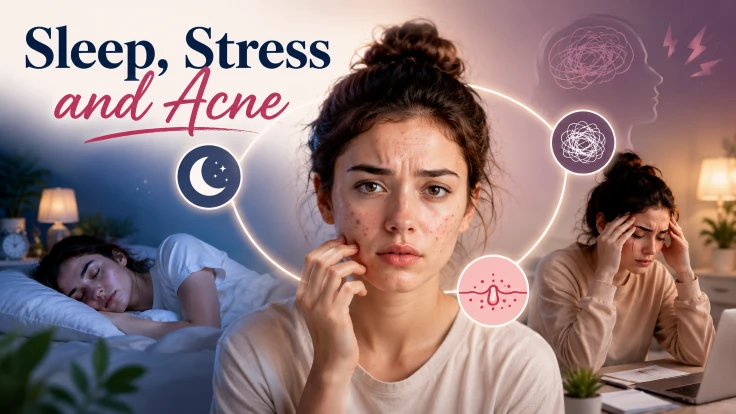
There is a strong connection between sleep, stress and acne that you might not consider as much when choosing your skincare routine. You’re sleeping in bed, scrolling through the episodes, comparing outfits between the third episode recap and the fourth outfit reel, when you realize you have a new breakout on your chin, and on the same week a deadline has been on your mind. You did NOT change your skin care. There was nothing you changed your eating habits to do. The only thing that has changed is the way that you’ve been sleeping and how wound up you’ve been. It’s no accident and is even a bit more direct than most skin care advice attributes.
One of the less talked about aspects of skin care that is related to sleep and stress is that it is one that is usually included last in the list as an add-on concept of ‘self-care’. However, there’s more to it than that, as the biology changes the focus. Let’s take a look at the eight ways these three factors are interrelated and what usually works for both.
If you currently have active acne, our 8 Daily Habits That Are Secretly Making Your Acne Worse and when to visit your dermatologist for acne have more in-depth information regarding the treatment aspect — this one is about the sleep and stress mechanisms that lie beneath it.
Understanding the Connection Between Sleep and Stress, and How It Manifests in Skin
You’ve never been subjected to a more specific and thorough treatment.
| Trigger | What Happens to Your Skin |
|---|---|
| Stress affects | Cortisol increases, oil glands increase output of oil |
| Eve of not sleeping well, no additional stress | Cortisol is up regardless of mood |
| Stretched sleep | Inflammation makes breakouts look angrier |
| Stress in pressure situation | Face touching and picking increases without being noticed |
| Repeatedly sleeping too short of time | The skin repairing window is reduced, skin becomes more reactive |
| Late nights | Late night habits (snacking, watching screen time, lack of skin care) add up |
| Increased chronic, sustained stress | Changes in hormone levels (not necessarily cortisol) |
| Persistent poor sleep | Existing acne pimples don’t heal as quickly |
1. Stress Hormones Tell Your Skin to Make More Oil
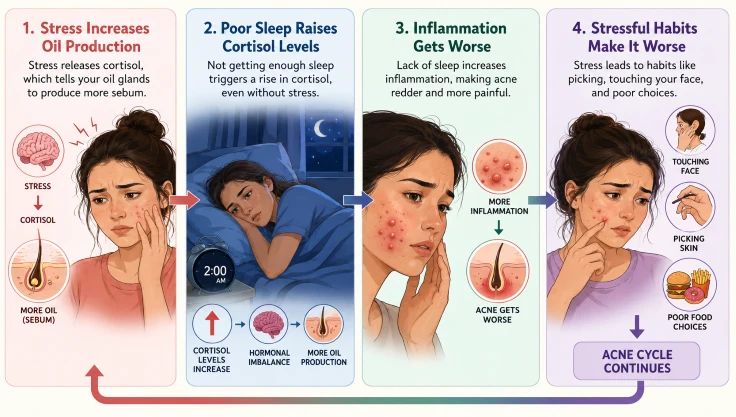
It’s that kind of week that you’re aware of, as you notice that your skin is a bit more oily on day three than normal, despite not changing anything about your routine. Not in your head! Cortisol is being released when you’re stressed, and skin cells contain cortisol receptors — when it binds to any sebaceous glands, it tells them to crank up the production of oil, aiding in the formation of a breakout.
It’s not only a theory regarding all stress hormones but it’s been followed down to the skin itself. The study, published in the British Journal of Dermatology in 2013, actually revealed that acne sufferers have more of a particular enzyme (11β-HSD1) in their skin which can locally produce cortisol; with higher levels of cortisol in the skin correlating to increased sebum production. This means that acne-prone skin could be more efficient at generating its own supply of cortisol, in addition to any circulating from stress.
This connection works both ways, to a certain extent: inflamed, acneic skin can be a source of stress, in turn, keeping the whole cycle going. It’s one of the more consistent mechanisms on this list; there is a fairly consistent link between higher cortisol and more sebum production.
Don’t try to eliminate stress (which is a lot harder than it sounds for most people), but if you notice the effect of your skin during stress weeks, you will be able to adjust your skin care routine at that time, instead of giving up on all skin care products and assuming that they don’t work when you are stressed.
Not all skin will react to cortisol in the same manner. Oily skin may be noticed in a day or two after some stressful event while for some, it may take a week or more. Even if you didn’t realize that stress is a possible cause of acne before, you can keep a log of your stress level – even a note on your phone that you record on the evening – and see that it is directly linked with your skin.
2. Without Additional Stress, Cortisol Levels Increase as a Result of Poor Sleep
You might find this surprising, but it doesn’t have to be a stressful event to trigger up a rise in cortisol. The lack of sleep causes the body to have a hormonal imbalance on its own, without even a specific stressful situation, which can cause a similar hormonal change as an actual stressful event.
This is important because if it is said that you are not stressed, it is more likely to be true if it is said that you are just tired. This is a likely part of the reason breakouts can happen when you don’t think you’re feeling emotional stress, but you are definitely getting a lack of sleep (like during travel, exam times, babies, stressful work periods, etc.).
When your skin reddens during a hectic time: If your skin is red, try to look at your sleep window, and see what it has been like in the last week or two, and not just at what you eat or put on your skin.
There’s also one that surprises people: The “revenge bedtime procrastination” phenomenon of doing something low- or small-effort, fun thing, like browsing on Instagram, watching a show or playing a game, just because it’s the only time that feels like their own. It is not stressful at the time! In fact, the loss of sleep caused by this particular habit does still increase cortisol levels, which is why this habit tends to be ignored as a skin factor.
3. Inflammation Increases When You’re Sleep-Deprived
Not only are acne lesions the result of blocked pores, but inflammation is a key factor in the visibility and painfulness of an acne lesion! In fact, another study that measured changes in the skin barrier function after a controlled 42-hour sleep restriction showed that skin barrier recovery was significantly decreased, and plasma levels of 2 important inflammatory mediators, IL-1β and TNF-α, were significantly increased, effects related to worsening inflammatory skin disorders such as acne. A more comprehensive review of sleep and skin function reached a similar conclusion: sleep disturbances increase systemic inflammation and decrease barrier function, both of which have been linked to worsening inflammatory skin conditions, including acne.
If you have acne, the same clogged follicle that may have been a small, easy-to-ignore bump on a good sleep night can look redder, more swollen and more visible when you are not getting good sleep. The blockage may not be that severe — it is the inflammation surrounding it that’s causing more harm.
This is also why it’s not uncommon to see a pattern in many people: a same spot can appear so completely different from week to week. One that appears on waking from a good night’s sleep will probably remain small and diminish in a few days, but if it appears upon waking from several poor nights, it will become angrier and persist longer. One of the lesser-known answers is that your skin may experience “over-reaction” some months and not others, perhaps due to inconsistent sleep.
4. Stress Situations Can Induce a Habit That Worsens Acne, but You Will Not Be Aware of It
This isn’t hormonal, this is behavioral and it’s easy to miss because the behaviors feel like they have nothing to do with skin — a reminder to us, that the sleep, stress and acne cycle isn’t just a chemical one. Many people begin to touch their face more when stressed, such as putting their chin in their hand while on a stressful phone call, touching their face while thinking through a problem, and running their hands through their hair then across their jawline without realizing.
None of these are failings, it’s just a normal reaction to stress. But repeated touching spreads oil and bacteria, and picking – especially – increases the risk of inflammation and scarring because it disrupts already healing skin.
Self-check: When you’re next under stress during a call or task, observe yourself to see how often your hand goes to your face, many people are completely oblivious until they pay attention during a stressful call or task.
If picking is not occasional but rather compulsive, make an appointment to see a dermatologist or therapist; see our note on that below in the FAQ.
5. Your Skin Rebuilds Itself During Sleep – But Not When You Don’t Get Enough
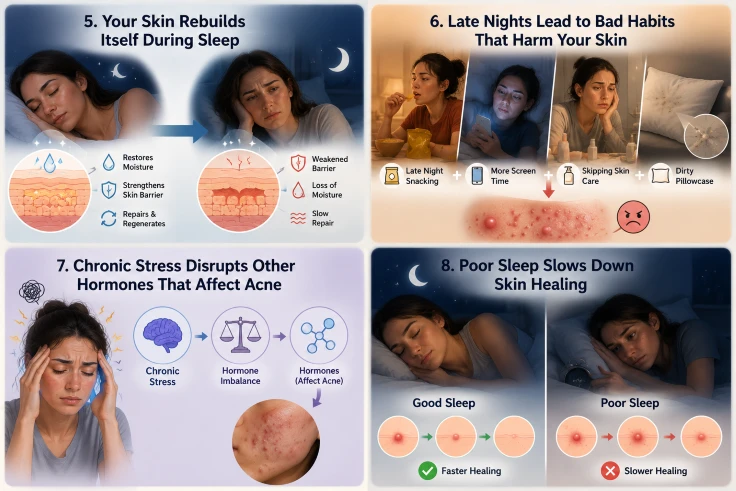
Refreshing and repairing, in a meaningful way, occurs in the skin during sleep, such as regulating moisture and reinforcing the skin barrier, the outermost layer that keeps irritants out and moisture in. Any disruption of this rhythm, such as losing sleep, diminishes the ability of the body’s repair system to regenerate tissue, including collagen, and to replace dead cells; it makes the barrier more reactive, more easily triggered by products that used to work for it and slower to calm after an acne flare.
This is an area where there is good evidence, but not as hard-and-fast — there’s a general idea that a few poor nights of sleep can impact the barrier, but the exact amount by which it becomes impaired is less well established (less clear, say, than weeks of bad sleep). To be treated NOT as an exaggeratedly large value, but as a real value.
6. Late Nights Often Go Hand-in-Hand With Bad Habits, Which Can Have a Negative Impact on Skin Health Independently
This is a second, but not uncommon connection: Late-night eating is not only a reduction of sleep, it may also lead to behaviors, such as late night snacking, more time in front of screens with the face resting against the pillow, or putting off that skin care step because you’re too tired when you finally get in bed.
What you’re reaching for during those late-night stretches matters too — some drinks calm inflamed skin while others quietly feed a breakout. Our 12 Best and Worst Drinks for Acne-Prone Skin breaks down which ones actually help.
None of these are big changes by itself, but together over a number of short-sleep nights, it’s easy to point to them as all being due to “stress,” when in fact it is just a few small habits, all linked to sleep.
There’s also a physical part to this: The pillowcase won’t change as often during a hectic period with less sleep and therefore will be infused with oil and product residue at a rate that exceeds many people’s expectations, and a face pressed against the pillowcase for an entire night can spread residue straight to the skin. Pillowcases don’t have the same compelling links to acne as the hormonal mechanisms above — it hasn’t been thoroughly investigated — but it’s also something you can easily control, and something you often forget to take care of when you’re in the throes of acne.
7. Chronic Stress Can Interfere With Other Hormones in the System Other Than Cortisol
Unlike the direct link between cortisol and oil production, this mechanism is not as commonly accepted, but has been demonstrated in research that measures testosterone, androstenedione and cortisol all relate to acne severity, therefore suggesting that cortisol has a role in acne besides just increasing oil production. This may be a less consistent mechanism by individual and research has shown that other hormones, such as testosterone and androstenedione, also impact the severity of acne.
Where this manifests realistically: when acne occurs when there’s a stretch of stress in the life, but not necessarily when there’s a particular stressful day, and only gets better when the stressful stretch of life gets over. This is often the case in people who already have hormonally triggered acne patterns (breakouts tend to be clustered on the jawline and worse during certain weeks of the month), who may see this connection most clearly because a period of intense stress can exacerbate a pattern that was already there, but not cause it to start.
Any dermatologist will recognize that the lower face and jawline is a common area of acne that should be mentioned specifically if it is consistently occurring there – it’s one of the more common hormonal causes of acne.
8. Poor Sleep Will Diminish Your Skin’s Ability to Heal Any Existing Acne
New acne can’t clear up as fast if it is worsened by sleep. To acne, it may mean that a pimple that normally gets better within a week taking even longer, or a redness after acne taking significantly longer to fade.
This link is hard to notice as it doesn’t lead to new acne, but it does help the existing acne stay there and that can make a skin care system seem much less effective than it is.
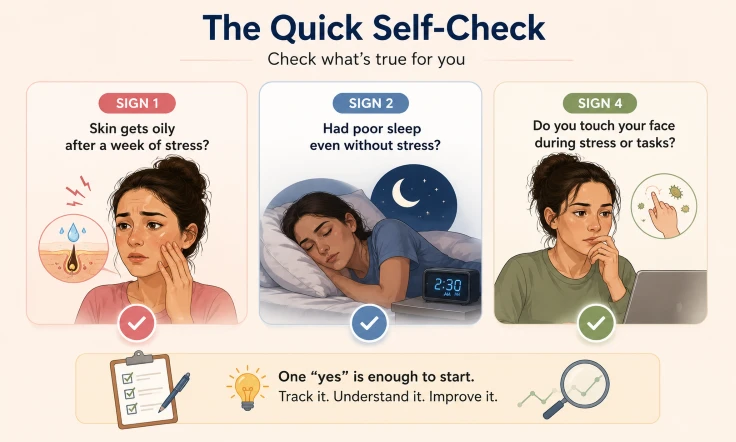
The Quick Self-Check
However, before you begin fixing, you’ll want to identify which of the following is/are true for you:
- If your skin becomes visibly oily after a week of stress, you might want to think about reviewing these details. (Sign 1)
- Have you had a few nights of poor sleep that aren’t due to being particularly stressed? (Sign 2)
- Ever have the hand close to the face during a stressful situation or activity? (Sign 4)
There doesn’t have to be a “yes” to all three — a “yes” to one is enough to begin monitoring, tracking is what turns a feeling of “my skin’s just bad right now” into something you can do something about.
Avoid an Overhaul, and Discover What Really Helps
No, none of this means you have to get 8 hours of uninterrupted sleep and no stress at all to see clear skin — that’s not a realistic standard for most and setting that may only increase the stress. A few small, specific changes have a greater impact than people think:
- Ensure a sleep onset rather than sleep hours. The key is not so much about the total amount of time spent on screens but how much is spent in the last 20-30 minutes before sleep. What matters more here than exact hours of screen time is the amount of time spent in the last 20-30 minutes before bedtime.
- Be sure to observe yourself instead of taking any assumptions. For some people, it’s a skin that’s more prone to sleep than stress, or vice versa — you can see your skin’s patterns of breakouts for a couple weeks and know more than you could ever learn from a skin rule.
- Talk about touching or picking rather than as a problem of willpower. Activity is more effective during stressful calls or tasks, than trying not to hold hands (use a fidget object, a habit of clasped hands).
- If you’re looking for the perfect sleep schedule, you might as well find the perfect skin care schedule as well. Typically, they reinforce one another, but when you have a very challenging period, a rushed bedtime routine is better than a missed bedtime routine.
When It’s More Than Sleep, Stress and Acne Habits
When lifestyle changes aren’t making a difference — if you’re struggling to get rid of your acne even when you’re taking steps to change your lifestyle, such as getting more sleep and managing your stress, for example, and if you’re having painful breakouts, breakouts that are cystic or scarring, that’s when you should seek a dermatologist’s opinion instead of more self-monitoring. There is a connection between sleep, stress and acne – and it’s not something that is often ignored, but it’s not the only reason.
Small, sustainable modifications to sleep and stress habits won’t be a substitute for a skin care regimen or professional treatment when needed — but when they are, they will take away two of the lesser obvious causes that may sabotage an effective skin care routine, so that alone is worth considering.
FAQs
Q1. If it is a hereditary condition for me to break out, what difference does sleep make anyway?
It does not take away the triggers, but a genetic predisposition to acne will largely determine the reaction of your skin to triggers. What happens in one person’s life may be different from another’s, even if both are genetically sensitive—if one is more consistent with sleep patterns, or more sensitive to stress, or both. That’s why the sleep, stress and acne connection is important even to acne-prone skin, for this is what determines the frequency and visibility of the predisposition.
Q2. Or does it have to do more with stress or how I react to stress on my skin?
Both appear to contribute, and it is difficult to fully differentiate the two. The hormonal change from stress occurs even if you do it consciously or not, but coping patterns (face touching, not taking care of skin, missing sleep) can be a factor in aggravating the hormonal change. That is why it is important to address coping behaviors when the stressor is not likely to change anytime soon.
Q3. Do naps during the day compensate for the night's sleep for skin?
Partially. Though naps can help relieve daytime fatigue and help to lower cortisol, they don’t provide the same benefits of a full night’s sleep in terms of deep sleep and hormone regulation. If you are having a bad week, it’s okay to take a nap or nap for a while, but not all night.
Q4. Does exercise bring a break in the cycle: stress-acne, or can sweat be a catalyst to make it worse?
They are both true, if you do what follows. It may be good news, but it can also be bad news because high-intensity workouts can temporarily increase cortisol levels in the short term, but the calming effect is likely to occur over the long term — and the key is to rinse away the oil and sweat relatively quickly after exercising, before it clogs pores.
Q5. Does improved sleep and stress management actually decrease the risk of acne scarring, or just stop new acne from breaking out?
To some extent both. As inflammation is a factor in breakout scarring, and sleep is a direct factor in inflammatory regulation, improved sleep and reduced stress levels can potentially decrease the risk of scarring over time — not only the incidence of breakouts. It’s a benefit that is going to take time before it becomes evident.