


Introduction
You’re closer to the mirror than you realize, tilting your chin under the light, trying to figure out whether that new bump under your jaw is just another pimple or something more. If you’ve searched “Should I See a Dermatologist for Acne?” more than once, you’re not alone. Many people wonder when acne has crossed the line from a common skin concern to a condition that needs professional treatment. If that question keeps coming back, it’s often worth paying attention to.
That’s a good instinct to follow. Many people wait far longer than they should before scheduling an appointment with a dermatologist because it can be difficult to tell whether acne is simply frustrating or a sign of a deeper problem. The truth is, you don’t have to wait until your skin becomes severely inflamed or painful. Often, a few specific warning signs are enough to indicate that it’s time for expert care.
Before assuming your skincare routine is the only factor, remember that what you eat may also influence your skin. If you’re wondering whether certain foods can trigger or calm breakouts, check out our guide on Acne and Diet: What to Eat, What to Avoid, and Why It Actually Matters to understand how nutrition may fit into the bigger picture.
In this guide, we’ll cover 7 signs you should see a dermatologist for acne, explain what’s happening beneath your skin in each situation, and outline what you can expect during your visit. Seeking professional help early can reduce the risk of permanent scarring, shorten the time it takes to control breakouts, and help you find a treatment plan that’s tailored to your skin.
1. Avoid Using Anything From the Drugstore Aisle
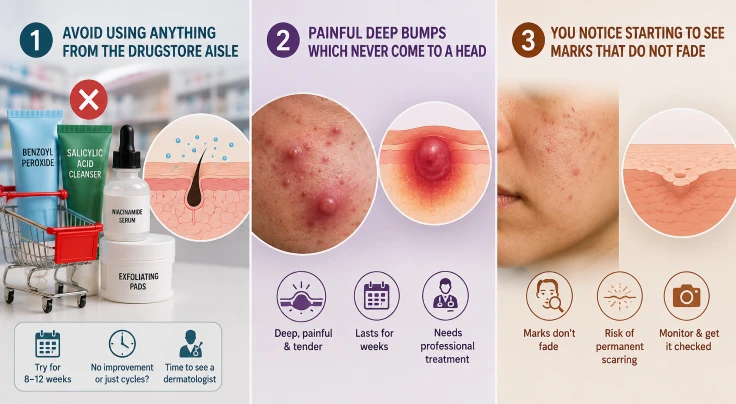
You’ve tried the benzoyl peroxide, perhaps the salicylic acid cleanser suggested by that website, and perhaps even a niacinamide serum. You had each one for 6-8 weeks. Each one was treated for 6-8 weeks. And your skin looks… Well, about the same. Perhaps a bit better on a good week, but the following week not so good.
One of the more trustworthy indicators you should visit a dermatologist for acne is that over the counter products do a relatively superficial job of treating acne, basically, they can exfoliate the skin’s surface and help to decrease the amount of bacteria on the surface. However, these ingredients are typically unable to reach the true cause of acne, when the problem is, for instance, an overproduction of oil, regulated by hormones or blocked follicles deeper under the skin. You did NOT use the product incorrectly. It’s because there are some acne that requires tools that cannot be sold without prescriptions such as topical retinoid in stronger concentrations, oral treatment or hormonal treatment.
The 8–12 week time frame is a good benchmark for how long you should try a product for before you start to feel it’s not doing the trick, and it’s time to seek some expert advice.
There is also a “lesser” version of this sign: some people are not worse, they simply “plateaux. Breakouts go on the hibernation during the time when they are not active, but they come back as soon as a product comes back on the market, and they go on hibernation again when it hibernates again. This cycle may continue for years before anyone calls it “not working” since the product is performing some function. It would probably be called a maintenance pattern, not a treatment, by the dermatologist and it is frequently a symptom that there is something that is still there as a trigger and being suppressed, not solved.
Before moving on to stronger treatments, it’s also worth checking whether your everyday routine is working against your skin. Small habits can have a surprisingly big impact on persistent breakouts. Learn more in our guide, 8 Daily Habits That Are Secretly Making Your Acne Worse, to see if one of them is affecting your skin.
2. Painful Deep Bumps Which Never Come to a Head
Not all acne will act the same. A whitehead appears, and will eventually subside. A nodule or cyst, on the other hand, does not appear on the surface, is sore to the touch, and will remain swollen and tender for weeks without ever having a “top”.
These deep pimples are among the more serious indicators of severe acne, as opposed to the surface-acne that most people experience. Cystic acne results when the blocked pores (follicles) break through the skin, prompting more skin tissue to be drawn into the lesion, resulting in a greater inflammatory response. That’s why, just as with a regular pimple, a cyst hurts more than just the inflammation — it’s physically different.
Self-check: If you notice more than three, four, or so of these deep and tender pimples at a time, or if you’ve had one that persists for more than 2 weeks, it’s time to call in the professionals.
Benzoyl peroxide gels that are made for treating surface acne are not likely to penetrate to this depth and thus may have little effect against a cyst. It’s not that they don’t try hard enough. With the topical treatments, they are making their effects on the surface of the skin, and with the cystic treatments, they are occurring deep within the skin. This form of acne is more common, because it treats the acne from the inside, as opposed to something that is applied to the surface, and is usually treated with oral medications, corticosteroid injection by a dermatologist or prescription strength retinoids.
3. You Notice Starting to See Marks That Do Not Fade
Redness or dark marks are normal and typically will clear up on their own. But when it comes to real acne scars, it’s a slight dip in the skin that feels slightly textured to the touch when you run a finger over it or a patch of skin that still looks textured even when you’re not breaking out.
This should be taken seriously in particular because some of the changes caused by acne is much easier to be dealt with early than later, namely the scars. The research on acne scaring seems to agree with this: pitted or “atrophic” scars are caused by damage to the structure of collagen in the skin during the healing process of acne, and it is more complicated to fix the skin’s collagen structure than to prevent it from being damaged to begin with. The severity of the breakout is also not the only deciding factor in determining whether a particular breakout will scar or not; it depends on some of the skin types and healing tendencies of the individual, the type of dermatologist judgment call.
Self-check: Take photos periodically within the same lighting of areas you are concerned about, every couple of weeks. A month after it remains indented instead of just stained, it’s a good time to get it looked at.
4. Your Acne Showed Up Later Than You Expected
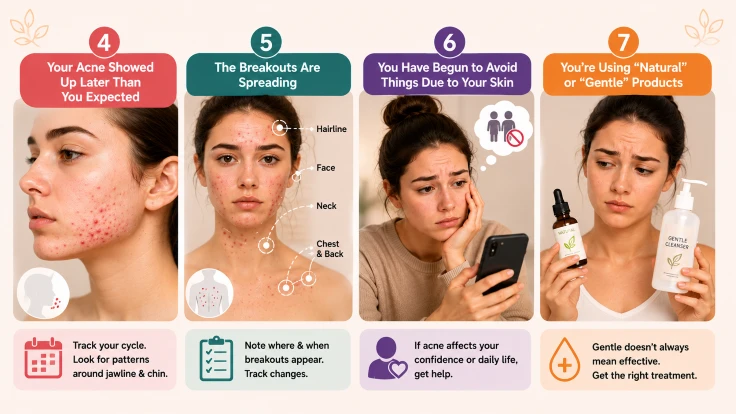
Adult onset jawline acne is another form of acne that needs a dermatologist’s attention and is definitely not like the acne found in teens. Perhaps your skin was pretty clear for your teenage and twenties years and then at some point in your late twenties or thirties, breakouts began around your jawline and chin — sometimes during certain weeks of the month, sometimes in ways that were difficult to treat (or not treat) when you were younger.
This type of acne is one of the more unique symptoms of hormonal acne and it is really different from the usual acne breakouts of adolescence in both cause and treatment. Adult onset, jawline acne is treated differently, as it may be more hormonal than the acne that typically affects teenagers, and many dermatologists prescribe a different treatment. In this case, “just let it go” may not work as it did for a 16-year-old — acne in adulthood is more likely to persist until treated.
Self-check: For 2-3 months, monitor your breakouts by keeping track of your cycle (if applicable). If there is a visible trend, it’s a worse week in the same week of each cycle, and it’s focused on the bottom half of the face, it is information that can be taken right to the dermatology visit.
It is important to note the established facts here, and the fact that certain issues remain contested. This association of hormone fluctuation and jawline acne is pretty well established and is readily identified by most dermatologists. The cause of the difference in when some individuals start compared to others remains unclear: that is, some people begin later than others, due to genetics, stress, shifts in birth control and other personal reasons, but not everyone has a single answer. That’s why it’s always best to get professional advice on this particular sign instead of relying on just gut instinct – the pattern is clear, but the best treatment will be determined by the individual situation.
5. The Breakouts Are Spreading Past Where They Started
If acne remains localized to one area (even when it persists) it is different than acne that continues to spread — from the jawline to the neck, forehead to hairline, chest and back to the face. Multiple spots occur when there is an underlying cause to acne that a regular skin care regimen is not treating, such as hormonal changes, a reaction to a drug, or when the acne is severe enough to require oral treatment and not merely topical.
Let’s get honest about this — not all breakouts occur in the same pattern indicates an issue, and some changes in where breakouts occur is natural — a stressful week may trigger a breakout on your chest, unrelated to facial acne. However, if you notice a notable improvement in your skin over a period of weeks, particularly when you’ve begun a new medication, started a new birth control, or undergoing a large amount of stress, it’s a good reason to seek a professional opinion, not to experiment with skin care products without consulting anyone else.
Self-check: Make a quick running note (even on your phone) of where the breakouts are occurring and about when they are occurring. The skin map of your skin is another detail to note when you book, and if it is markedly different from what it was two months ago, it will alert the dermatologist to the timeframe even more than the breakouts.
6. You Have Begun to Avoid Things Due to Your Skin
While it does not happen to everyone, it’s just as much one of the signs you should see a dermatologist for acne as anything physical happens. No, you’re not crazy for avoiding video calls, not lighting up just so you don’t look worse that week, or making some adjustments to your plans because your acne looks worse than it does on the other day — they’re all normal, understandable responses, and that’s perfectly okay to seek care for, regardless of how “severe” your acne technically is, by clinical standards.
Dermatologists do not consider acne solely based on the number of acne lesions. The impact of daily life is a serious component of the discussion as well as an entirely legitimate reason to book an appointment even if you’re not certain your skin is bad enough.
7. You’re Using Products That Claim to Be “Natural” or “Gentle”
You’re using products that claim to be “natural” or “gentle” because you’re afraid of side effects — and you’re only making yourself look worse.
This one is subtle. Many people choose less potent and more natural formulas just because they’re more difficult to use or because they’ve heard that some use them as a treatment have experienced dryness and irritation. That instinct is natural, but if your acne is getting worse despite your taking on a gentler approach to prevent the problem, you may be doing more harm than good.
Instead of having to decide between “too harsh” and “not effective,” a dermatologist can help you pick a version that’s not as strong, not introduced at as fast of a pace, or formulated to be less irritating, depending on your skin’s tolerance. One of the biggest factors to distinguish store-bought products from dermatologist-led treatments is that prescription strength treatments include instructions that are specific to your skin, rather than a one-size-fits-all.
What to Expect at Your First Dermatologic Acne Appointment
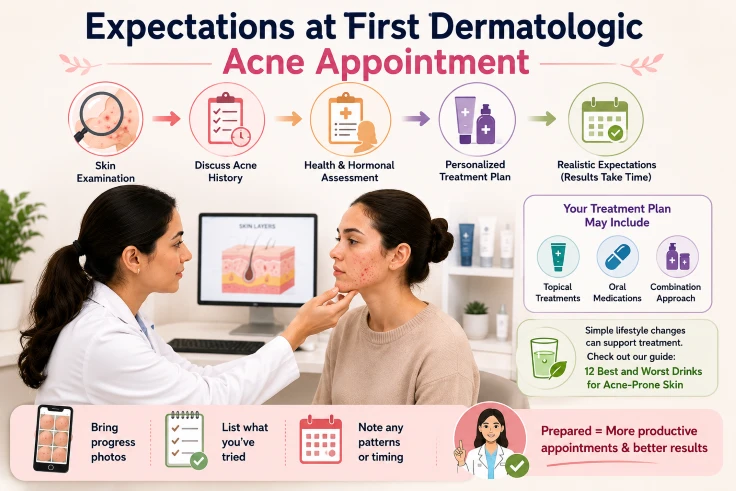
Whether you’ve identified one of the symptoms to see a dermatologist for acne, the typical course of your first acne appointment will include the dermatologist examining your skin and asking about your acne history: when it began, what’s worked/not worked for you, any patterns you notice, and possibly some additional information about your health if they suspect hormonal acne. At this point, most dermatologists will recommend a course of treatment, which may involve topical, oral, or a combination approach and share a realistic expectation of results — because most acne treatments take weeks to see results. Along with prescription treatments, your dermatologist may also recommend simple lifestyle changes. One easy place to start is your daily beverages. Check out our guide, 12 Best and Worst Drinks for Acne-Prone Skin, to learn which drinks may help support healthier skin and which may contribute to breakouts.
Having an additional few weeks’ worth of pictures of your phone, a list of what you’ve already done, and any pattern that you have identified (such as noticing that your skin has a certain rhythm in terms of when you have acne, for instance) makes that initial discussion more productive – if nothing else, it gives your dermatologist a bit more to work with than just one picture of what your skin looks like on that one day of the week.
Conclusion
Not every breakout needs a dermatologist. Mild, occasional acne that responds to consistent OTC care over a few weeks is common and doesn’t necessarily require a specialist. The signs above are meant as a general guide, not a rigid checklist — your own skin’s response over time is the most useful information you have, and it’s worth paying attention to rather than assuming any single sign applies exactly to your situation.
But if you’re recognizing two or three of these signs you should see a dermatologist for acne at once — persistent breakouts despite consistent treatment, painful cystic bumps, marks that aren’t fading, or a pattern that’s clearly changed — that’s a reasonable, non-dramatic reason to book an appointment. You don’t need your acne to reach some imagined worst-case threshold to justify professional care. Recognizing the signs early, before scarring sets in or before months pass without improvement, tends to make treatment more straightforward — not because you waited too long, but because earlier is simply easier to work with than later.
FAQs
Q1. Will my acne come back after treatment stops?
It depends on what kind of acne you had and what treated it. Some acne resolves fully once the underlying trigger — a medication reaction, a temporary hormonal shift — passes, and it doesn’t return once treatment stops. Other forms, particularly hormonally driven adult acne, tend to need ongoing maintenance, similar to how some skin conditions are managed rather than cured outright. A dermatologist can usually tell you which category your acne likely falls into based on what’s driving it, and will often suggest a lower-maintenance routine to step down to once your skin has cleared, rather than stopping treatment abruptly.
Q2. Is it worth seeing a dermatologist if my acne is mild but just won't go away?
Yes. Severity and persistence are two different things, and dermatologists regularly see patients whose acne is mild in appearance but hasn’t meaningfully improved in months or years despite consistent care. “Mild but stuck” is still a sign something about the routine or underlying cause isn’t being addressed, and it doesn’t need to escalate to something more severe before it’s worth a professional opinion.
Q3. What's the difference between a dermatologist and an esthetician for acne?
A dermatologist is a medical doctor who can diagnose the underlying cause of acne, prescribe medication, and treat scarring or cystic lesions that require more than surface-level care. An esthetician is trained in cosmetic skincare — facials, extractions, product recommendations — and can be a helpful complement for maintenance, but isn’t licensed to prescribe treatment or diagnose what’s driving persistent or severe acne. If a sign on this list applies to you, that’s generally a dermatologist visit rather than an esthetician appointment.
Q4. Is it normal for acne to get worse before it gets better on a new treatment (purging)?
For certain treatments, yes — particularly retinoids, which speed up skin cell turnover and can bring existing clogged pores to the surface faster than they’d otherwise emerge. This can look like a temporary flare in the first few weeks. The distinction that matters is duration: purging typically settles within four to six weeks, while a true reaction to a product tends to keep getting worse rather than turning a corner. If you’re past six weeks with no improvement, that’s worth flagging to whoever prescribed the treatment.
Q5. Can I see a dermatologist for acne even if I'm an adult and think I'm "too old" for it?
Yes — there’s no age cutoff for dermatology care, and adult acne is common enough that most dermatologists see it regularly rather than treating it as unusual. Adult-onset acne, especially the jawline pattern described earlier, often has a different underlying cause than teenage acne and responds better to treatment aimed at that specific cause, so age is a reason to describe your history accurately, not a reason to skip the appointment.
Q6. Can stress alone cause acne, or is something else usually going on?
Stress on its own is rarely the sole cause — it’s more accurately described as an amplifier. Stress hormones can increase oil production and inflammation, which can make existing acne-prone skin flare more visibly, but it typically isn’t the root cause the way hormonal shifts or genetics can be. If breakouts consistently track with stressful periods, that’s useful information to bring to an appointment, but it’s usually one factor layered on top of something else rather than the whole explanation.